 I’m assuming most people already know this, but if you did not, today is Data Privacy Day. Given that those in control of the wheels of the digital market square we call the Internet do not value our privacy, we have to take this day, every day, to remind us – and them – that privacy matters.
Everyday should be a Data Privacy Day, but there’s nothing wrong in setting one day aside to mark it.
According to Data Privacy Day:
Data Privacy Day is an international celebration of the dignity of the individual expressed through personal information. In this networked world, in which we are thoroughly digitized, with our identities, locations, actions, purchases, associations, movements, and histories stored as so many bits and bytes, we have to ask – who is collecting all of this – what are they doing with it – with whom are they sharing it? Most of all, individuals are asking ‘How can I protect my information from being misused?’ These are reasonable questions to ask – we should all want to know the answers.
I’ve been asking those questions for a very long time, and trying to see what I can do about it. There is no single solution to “How can I protect my information from being misused?,” but I think I have found one to help protect my privacy when I’m searching the Web. By pure coincidence, I found it on Data Privacy Day. Luck me.
Google is the search engine of choice for majority of netizens. But Google does not respect your privacy. Here’s what Google’s CEO, Erin Schmidt , said:
If you have something that you don’t want anyone to know, maybe you shouldn’t be doing it in the first place, … The reality is that search engines, including Google, do retain this information for some time, … We are all subject in the United States to the Patriot Act. It is possible that that information could be made available to the authorities.
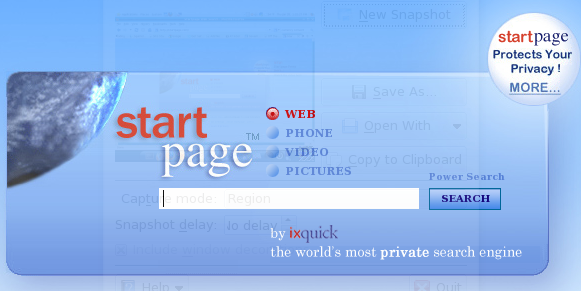
Passing “that information … to the authorities” is not the only problem. That information is also sold to third parties, and Google is not the only criminal. Microsoft, Yahoo, and others also do it. But lucky me, I’ve found a search engine that does not store information about me and, therefore, does not have anything to sell or make “available to the authorities.” And that search engine is Startpage.com. Startpage is registered with the Dutch Data Protection Authority and received the first European Privacy Seal Award. Read more about their thoughts on privacy.
For me, I’m happy to announce that I’ve made Startpage the default search engine for Firefox. Happy Data Privacy Day!