I gave Sabayon a spin a few months ago. I learned a great deal while playing around with it, and there is much to like in the Distro. However, the accumulation of minor irritations led me to abandon it back in April.
I keep thinking of giving it another go, but on the basis of this review, will probably wait and see what 5.4 looks first.
Interesting comments from some of the Sabayon Linux devs about issues raised in this review.
abhifx
15 years ago
a great distro for those who are starting with linux… easy to maintain too, sadly this is not for me.
ronw
15 years ago
Even with a root account, sudo makes sense to have, especially when it is configured to not allow starting a root shell (or running a command that can create a shell). For one, it allows sharing admin access without sharing the root pass word. For another, it allows granting only a subset of commands. In fact, each user can be granted a different subset of commands. Also, properly configured, sudo will provide better logging of who ran what commands as root.
In specialized usage environments, sudo has its place, but on a desktop distribution pushed out to the general public, I do not see the need. On a distro using the root account system, sudo is one of those facilities that should not be installed by default, but be left to those that need it to install and configure.
davemc
15 years ago
Sabayon was my very first Linux Distro and it was a great place to start for someone with no experience in Linux. The community is fun and the developers are pretty cool folks. The Distro is a nest of bugs however, and the Developers are really not very interested in cleaning them up because they are too busy with future development, or they are simply not interested in fixing them.
Sabayon has strong and deep roots in Gentoo, a community that has a legendary reputation for being the very first among newby unfriendly Distro’s. Alot of the Gentoo attitude spills over into this Distro and you will see RTFM thrown around from time to time, and you will learn something about Linux, like it or not as I did. I appreciate Sabayon for helping me learn the fundamentals of Linux, and for teaching me that there is definitely greener pastures in Linuxland out there, like Fedora, Ubuntu, and ArchLinux.
Adriatic
15 years ago
The worst part of Sabayon experience is criminally bad support to setup static IP address.
Just look on the net, everyone is having problems with this.
I ended up being forced to use net-setup to set the static IP every time I boot the OS! It just forgets the setting one each reboot !!!!
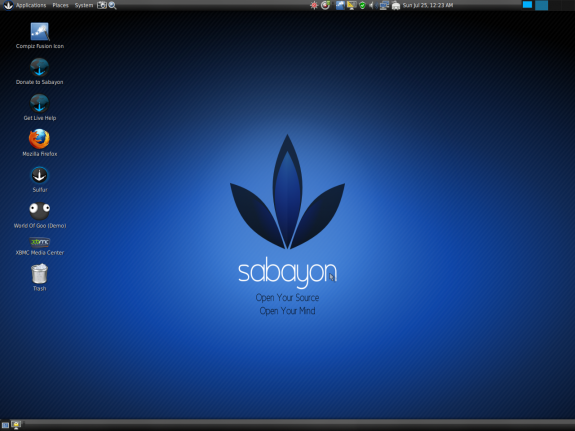
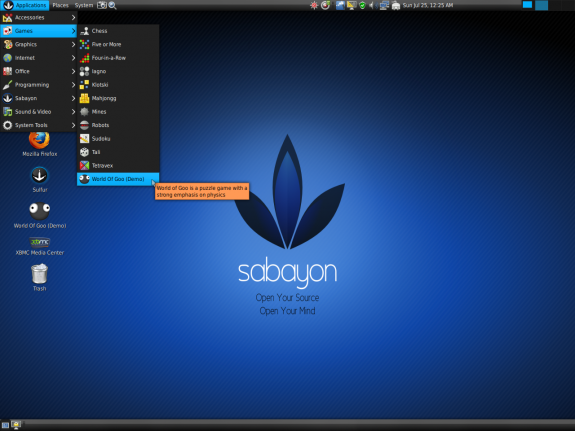
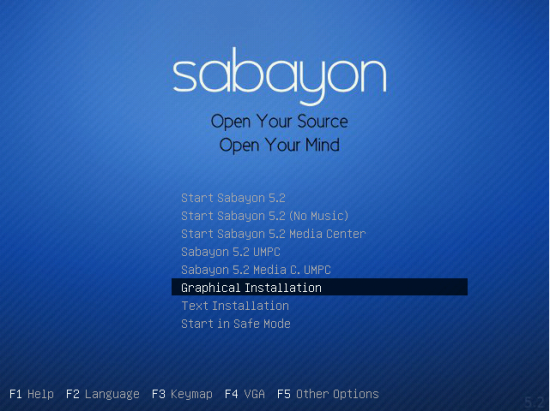

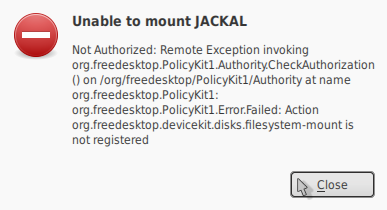




I gave Sabayon a spin a few months ago. I learned a great deal while playing around with it, and there is much to like in the Distro. However, the accumulation of minor irritations led me to abandon it back in April.
I keep thinking of giving it another go, but on the basis of this review, will probably wait and see what 5.4 looks first.
Interesting comments from some of the Sabayon Linux devs about issues raised in this review.
a great distro for those who are starting with linux… easy to maintain too, sadly this is not for me.
Even with a root account, sudo makes sense to have, especially when it is configured to not allow starting a root shell (or running a command that can create a shell). For one, it allows sharing admin access without sharing the root pass word. For another, it allows granting only a subset of commands. In fact, each user can be granted a different subset of commands. Also, properly configured, sudo will provide better logging of who ran what commands as root.
In specialized usage environments, sudo has its place, but on a desktop distribution pushed out to the general public, I do not see the need. On a distro using the root account system, sudo is one of those facilities that should not be installed by default, but be left to those that need it to install and configure.
Sabayon was my very first Linux Distro and it was a great place to start for someone with no experience in Linux. The community is fun and the developers are pretty cool folks. The Distro is a nest of bugs however, and the Developers are really not very interested in cleaning them up because they are too busy with future development, or they are simply not interested in fixing them.
Sabayon has strong and deep roots in Gentoo, a community that has a legendary reputation for being the very first among newby unfriendly Distro’s. Alot of the Gentoo attitude spills over into this Distro and you will see RTFM thrown around from time to time, and you will learn something about Linux, like it or not as I did. I appreciate Sabayon for helping me learn the fundamentals of Linux, and for teaching me that there is definitely greener pastures in Linuxland out there, like Fedora, Ubuntu, and ArchLinux.
The worst part of Sabayon experience is criminally bad support to setup static IP address.
Just look on the net, everyone is having problems with this.
I ended up being forced to use net-setup to set the static IP every time I boot the OS! It just forgets the setting one each reboot !!!!