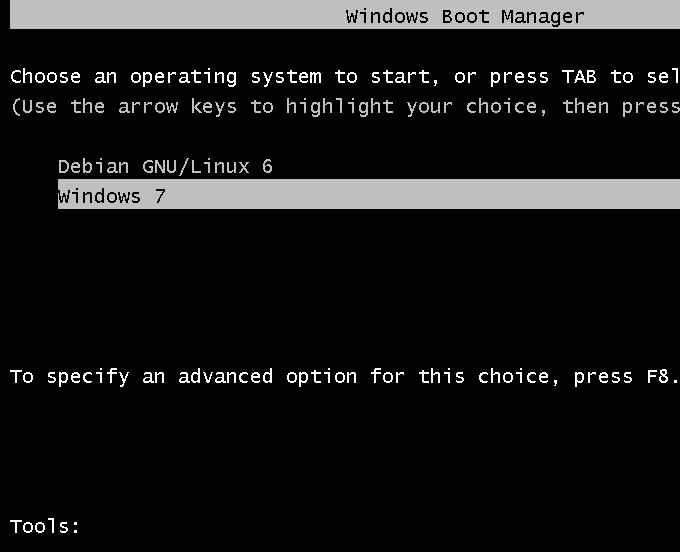
How to dual-boot Debian 6 and Windows 7

I am reading page: 1 2 3 4

Select “physical volume for LVM.” If you prefer installing the system on an encrypted LVM (recommended), select “physical volume for encryption.” Scroll to “Done setting up the partition.” Continue.
debwin17

With the PV created, scroll to “Configure the Logical Volume Manager” to create the Volume Group (VG). Continue.
debwin18

Yes. Note the partition number of the boot partition (partition #5). That piece of information will come in handy several steps ahead. Continue.
debwin19

Scroll to “Create volume group.” Continue.
debwin20

Give the VG a name. Any name will do. The shorter the better. Capitalization is optional. Continue.
debwin21

These are all the partitions on the disk. Which one will be made a member of the VG? Only a PV qualifies to be included in a VG. In this example, that will be /dev/sda6, the PV that was created earlier. Continue.
debwin22

The VG has been created. The next task is to create Logical Volumes, which are the equivalents of disk partitions. For this tutorial, only three Logical Volumes will be created: /, swap, and /home. You can create more if you like, but for a desktop system, those three should be all you need to create during installation. Continue.
debwin23

The first step in creating a Logical Volume (LV), is to identify the VG the disk space for the LV will be taken from. Continue.
debwin24

0saves
To have articles like this delivered automatically to your Feed Reader or Inbox, subscribe via RSS or email. For simple comments, use the commenting system, but for more involved assistance, please use the Question & Answer section.
I am reading page: 1 2 3 4

43 Comments

  1. Gustavo says:

    Thank you very much for the excellent instructions. Best wishes

  2. madrid7 says:

    Perfect. Thanks so much!! :)

  3. Yannbane says:

    When you say “do this for other LVMs” at the mount point section, you should really explain that for the swap LVM, a different file system option needs to be used (“swap area” instead of “ext3″).

    Otherwise, great tutorial! Thank you very much.

  4. Jeremy Lukins says:

    I tried this with Windows 8 but once Debian was installed (with a few errors) it wouldn’t bring up a boot menu and I lost my Windows 8. (Not a big problem as it doesn’t take long to re-install and it’s a machine to play with.)

    Do you know if there is something different with Windows 8? It’s a Dell Inspiron Duo with 2GB RAM. I know I don’t have specific error messages but I will try and get them.

    Thanks though, good blog.

  5. Nithin says:

    THanks a lot…thanku

  6. mohand says:

    Thanks a lot. Perfect tuto.

  7. New to Linux says:

    I have tried to install Debian on a Windows 7 machine using these instructions. During the installation and the partitioning process Debian showed the whole hard drive as free space even though Windows 7 64-bit is installed on the drive. Continuing with the installation lead to losing windows 7.

    Any ideas why is Debian is seeing the whole drive as free space?

    Here is the procedure used:
    I used the Debian 6. Booted from the Debian 6 CD. Selected Graphical Install. Followed the steps in this article.

    Thanks.

    • finid says:

      That is strange. Never has a situation like, especially with the Debian Installer.

      Did not try any of the other installer options, like Expert mode, for example.

    • mohand says:

      Check in Windows7 if your hard disk is mounted as dynamic disk and not basic one in which case you’ll have to do the conversion using the appropriate partitioning software with the necessary precautions of course!

    • thetsar says:

      I think that you have to go to Windows first, and “shrink” the partition to make room for Linux. Otherwise, Linux will grab the entire partition and bye-bye Windows.

      • finid says:

        Not necessarily. You can shrink any partition from the installer. You just have to be careful. The installer will actually do it automatically.

  8. Jaimyn says:

    Hello, I assume that you boot from the Debian CD instead of windows? Am i correct? (I’m just checking as i don’t want to wreck my pc)

    • Jaimyn says:

      Doesn’t matter. The tutorial assumes you have booted into the debian CD and have gone through all the steps up to drive detection. Btw thanka heaps for the very good tutorial. It is BY FAR the best out their.

  9. vitvrn says:

    Thank you! It was very useful.

  10. Chalon says:

    I’m confused, you use 20G for the home, 5G for the /root and 2G for the swap, so of the 114G you partitioned, you’re only showing me how to use 87G. How do I access the remainder?

    ty!! awesome guide tho btw :)

  11. Anonymous says:

    I would just like to thank you, this helped me out a lot.

  12. Alex says:

    Is it much more difficult to do this when you want to install Debian on a second HDD?

    I tried last night using the installer with default options (aside from picking a partition on the other HDD to use) and it failed miserably at the “install bootloader” stage.

Leave a Comment