Posts Tagged ‘linux news’
This is a press release from Fluendo announcing the launch of Flumotion Media Server and its own website.
This press release marks the official launch of the free software version of Flumotion. Flumotion is a streaming media server with a modern distributed design and advanced extensibility. Flumotion is being developed by Linux multimedia specialist Fluendo.
Flumotion is available for immediate download through the public website, http://www.flumotion.net/, including the full source code, which is licensed under the standard license of the free software world: the GPL.
Fluendo has announced the release of its Media Center, a software application developed by the Spanish company. Fluendo Media Center’s versatility was evident from the off when it was used for reproducing a whole manner of multimedia in a variety of devices using completely different platforms. Whether on Windows, Linux or Open Solaris; on netbooks, mobile internet devices (MIDs), notebooks or set-top boxes, Fluendo Media Center demonstrated not only its outstanding adaptability, but also its multiple features, attractive graphics and user-friendly interface. This first release will only be operational on Linux distributions but it is expected to get the application running on Windows in the near future.
It has now been almost exactly five years since kernel development community tentatively started using the git source code management system with the 2.6.12-rc2 commit. That was an uncertain time; nobody really knew how long it would take the development process to get back up to speed after an abrupt core-tool change. As it turned out, git was almost immediately useful, and has only become more so since. Making the development process work is git’s main claim to fame, but, as a side benefit, git also makes it possible to learn a lot about how our kernel is developed. And that, as it turns out, includes taking a look at the code which is not changed.
The speed of the development process is impressive; the nearly-released 2.6.33 kernel is the product of nearly 11,000 individual changes affecting nearly a million lines of code (look here for more 2.6.33 statistics). Those numbers are boringly normal for a three-month development cycle; things are always moving that fast.
OpenStreetMap and Sahana are two free software projects that are facilitating aid to Haiti.
We wanted to call attention to two free software projects that have been involved in the Haiti humanitarian effort, both because of the usefulness of their work and because they can surely use the help of skilled volunteers.
The first, Sahana, is free software for disaster management developed in response to the Sri Lanka tsunami in 2004. Sahana won FSF’s 2006 Free Software Award for Projects of Social Benefit. The Sahana software provides a portal page to disaster relief efforts. The best place to help out seems to be the wiki page devoted to development of Sahana’s Haiti response.
It’s official: China’s next supercomputer, the petascale Dawning 6000, will be constructed exclusively with home-grown microprocessors. Weiwu Hu, chief architect of the Loongson (also known as “Godson”) family of CPUs at the Institute of Computing Technology (ICT), a division of the Chinese Academy of Sciences, also confirms that the supercomputer will run Linux. This is a sharp departure from China’s last supercomputer, the Dawning 5000a, which debuted at number 11 on the list of the world’s fastest supercomputers in 2008, and was built with AMD chips and ran Windows HPC Server.
The arrival of Dawning 6000 will be an important landmark for the Loongson processor family, which to date has been used only in inexpensive, low-power netbooks and nettop PCs. When the Dawning 5000a was initially announced, it too was meant to be built with Loongson processors, but the Dawning Information Industry Company, which built the computer, eventually went with AMD chips, citing a lack of support for Windows, and the ICT’s failure to deliver a sufficiently powerful chip in time.
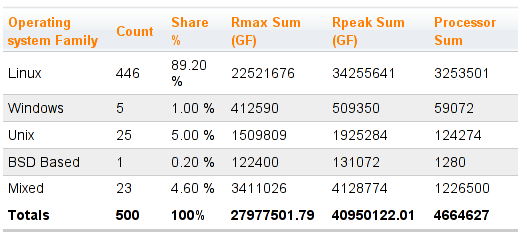
Data compiled by top500 shows that Linux is the operating of choice on supercomputers. That’s good news. The table (image reproduced below) does not go into details like which distro is the most popular on these supercomputers, but that’s not important. What matters is that we’ve won that battle.

If you want to introduce a group of people to the Web, a group that’s never used a PC, and have never used the Internet, what route would you take? Sell them a Windows PC, or one powered by a Linux operating system? My guess is it would be a Linux PC, and that’s is exactly what discount.age and Wessex Computers have done in the UK.
Observations from the Open World Forum and Open Source Think Tank – Paris, October 2009
Despite some logistical challenges and a very diverse agenda, the second edition of the OWF was a tremendous success, I believe most of the 1600 attendees came away very happy. This year the Open Source Think Tank was a single track within the OWF held on October 1 and 71 people participated in the think tank brainstorm session, more than 80% of them had not participated in a previous Think Tank event.
Astaro Security Gateway Home Edition, a free, Linux-based firewall-cum-router distribution, has just had its IP address limit bumped to fifty (50). Previously, users of Astaro Security Gateway HE were limited to using it to protect no more than ten (10), active networked devices. The IP address limit change was made known to license holders in an email message.
The Free Software Foundation (FSF) today announced that it will begin rewarding those who find and report any nonfree components in free software operating system distributions with public recognition and “GNU Bucks.” The FSF maintains a list of guidelines covering what it means to be a free distribution, and endorses distributions that commit to meeting those guidelines.
A few weeks ago, I switched my development environment from Windows to Linux, on a project which was developed so far on Windows only. In this post, I want to describe the issues that brought me to this switch, a short overview how I did the actual port, and some observations on Linux for developers. This is the first post in a series of at least two, the second post will describe the tools I use on Linux right now.
You know what Microsoft doesn’t get? — For one thing, the Internet.
Microsoft doesn’t control it. What it used to be able to do in the dark now falls out of its noxious bag of tricks into the Internet’s bright light, stage front and center. And there stands Microsoft in the spotlight, with its pants down, and let me tell you, it’s not a pretty sight.
Take the failed patent hustle of a couple of days ago, apparently maneuvering to enable proxy patent trolls to sue Linux. The idea, I gather, was to damage Linux, but without any way to trace it back to Microsoft. Thank you OIN and AST for foiling the plan. And by the way, are courts supposed to be used like this, to attack the competition? The court system is designed for adjudicating conflicts that are real. If you get damaged, you can go to court and try to be made whole. And so far as I know, there is no definition of abuse of monopoly that would exclude what just happened from being part of what antitrust law covers.
The uncertainty surrounding Net Neutrality has given rise to a technology known as Deep Packet Inspection (DPI) that offers Internet service providers unprecedented control over Internet content, according to a new paper released today by Free Press. Deep Packet Inspection: The End of the Internet as We Know It? argues that the use of DPI technology by Internet service providers should raise serious concerns for both users and lawmakers.
This afternoon, the MIT faculty unanimously adopted a university-wide OA mandate. Here’s the resolution the faculty approved (thanks to Hal Abelson, MIT professor of computer science and engineering, who chaired the committee to formulate it):